Business plan 2026 to 2027
Business plan 2026 to 2027
Published: 14 May 2026
We recommend viewing the PDF version of this document for the best reading experience. Alternatively, the plan is available in plain text below.
Business plan 2026 to 2027
Contents
- Foreword
- Our strategy
- Our guiding principles
- Our values
- The year ahead
- How we'll monitor progress
- Delivery and improvement
- Regulation and protection
- Prevention and impact
- Key performance indicators
- Resources
- Plan on a page (accessible version)
Foreword
Our business plan for 2026 to 2027 outlines what we aim to achieve during the year. It does not describe everything we will do but highlights our priority objectives, new areas of work and our key deliverables and measurements. It has been developed based on the experiences, learning and the ongoing collaboration we have had with key stakeholders in social work and regulation. Our business plan is also informed by government policy objectives and our strategy for 2023 to 2026.
Development of our next strategy was paused in November 2025, when the Department for Education announced that Dame Annie Hudson would lead the Independent Review of Social Work Regulation.
The review is required under Part 2 of the Children and Social Care Act (2017) and will ensure that the regulation of social work is fit for purpose and benefits both the individuals it aims to protect and the professionals it oversees. The review will consider how we are meeting our overarching objectives and delivering core regulatory functions including registration, professional standards, education and training standards and fitness to practise.
We look forward to the review’s findings which will guide our future direction. Once the findings are available we will consider our current priorities in this business plan and develop and publish our next strategy which will be shaped through engagement and co-production. The strategy will set out our long-term ambitions, our commitments to the profession and the public, and the principles that will guide our work.
The Professional Standards Authority for Health and Social Care’s (PSA) annual monitoring review of our performance in 2025 confirmed that we meet 16 of the 18 Standards of Good Regulation.
Timeliness within the fitness to practise process remains a challenge, however we have a clear plan to improve timeliness at each stage of the fitness to practise process, which we are implementing. Reducing delays and improving the experience of members of the public, employers and social workers remains a central priority for the year ahead.
One of the challenges we faced last year related to our ability to scale up activity quickly, to achieve the desired impact on fitness to practice case backlogs and timeliness. A major focus of this plan is how we can strengthen forward planning and utilisation of our resources. We will introduce a clearer and more consistent approach to long-term financial and workforce planning. Alongside this, we will continue investing in our digital, data and technology foundations to improve efficiency and user experience and long-term financial and workforce planning, enabling greater efficiency and improved organisational resilience.
We will focus on building capability, resilience, and the efficiency of our fitness to practice process. We will redesign the triage stage of fitness to practise so most concerns can be assessed and resolved quicker. We will build capacity and consistency across investigations and case examination and take targeted action to reduce the number of cases waiting for final resolution after case examination. Collectively, these improvements will further support fairness, transparency, and timely resolution. We will improve our communications to make them clearer, more accessible and easier for people to navigate.
Following the recommendations from the Independent Review of Social Work Regulation and feedback from the PSA, we intend to continue working on proposals to strengthen our approach to CPD, looking at what we require, alongside how social workers record their CPD and how we review CPD. We plan to consult on our proposals during the business year.
Our work on prevention and impact will deepen the insight, evidence and engagement that shape our regulatory model. We will establish a dedicated research function, set out our first research strategy and our priorities for the next year, and expand our national and regional engagement programme. New sector events, strengthened networks, and a national social worker survey will ensure our decisions are informed by the profession, employers, educators, and people with lived experience.
Everything we deliver relies on the dedication, expertise and commitment of our board, our people, and our partners. We will always be guided by our commitment to equality, diversity and inclusion, coproduction, evidence-based decision making and delivering value for money. Together, we remain focused on protecting the public and enabling positive change in social work.
Colum Conway
Chief Executive, Social Work England
Our strategy
Our strategy for 2023 to 2026 is based around 3 strategic themes:
- Prevention and impact: building trust and confidence within a safer practice environment.
- Regulation and protection: being transparent, efficient, responsive and fair in how we regulate.
- Delivery and improvement: putting our people at the heart of the positive change we want to drive and being able to unlock efficiencies and continual improvement.
Our guiding principles
In delivering our strategy, we are guided by our main principles:
- Equality, diversity and inclusion must be integral to and embedded in all we do. This must form a key part of the values and behaviours we bring as individuals and as an organisation.
- We will always listen to, engage with and co-produce alongside those who are directly influenced by our work. Co-production is about encouraging the people we work with, and for, to participate in and influence our work.
- We are committed to continual learning through the effective use of good quality data and insight, to ensure that we understand the impact we have and inform our future plans.
- We will use every opportunity to maintain and improve efficiency and effectiveness in the way we work, to ensure the best use of our funding and provide value for money.
Our values
- Fearless
- Independent
- Transparent
- Ambitious
- Collaborative
- Integrity
The year ahead
Our objectives for 2026 to 2027 focus on key and newer areas of work. We have not tried to capture all areas of our work in our objectives for the year. Alongside these objectives, we’ll continue to deliver our statutory regulatory functions and other business as usual activity.
In 2026 to 2027, we expect to:
- renew registration for over 105,000 social workers
- process around 8,000 new applications to join the register
- respond to around 65,000 phone calls and emails
- receive around 2,700 fitness to practise concerns
- conduct over 400 investigations
- make over 4,000 decisions about fitness to practise cases
- review around 400 current sanctions
- approve or reapprove 50 social work education and training courses, including approved mental health professionals (AMHP) and best interest assessors (BIA) training provision
- engage with around 10,000 people through a range of events across the year
How we'll monitor progress
We’ll use data and insights to understand our progress, improve our work, and ensure we are accountable for the public money we spend. Throughout the year we will track delivery of our objectives and key performance indicators, reporting quarterly to our board and publishing updates on our website.
This year, our new business plan approach strengthens how we monitor progress by focusing our objectives on clear deliverables and measurable outcomes, making it easier to see the difference our work is intended to achieve. We also focus on impact, not just activity, to ensure we can demonstrate real change over time.
We will regularly review our plans to make sure they remain achievable, and that our resources are used efficiently and effectively to support our priorities.
Delivery and improvement
To deliver our ambitions we will further evolve how we work. We remain focused on continuous improvement of the approaches and systems that underpin our work, and on fostering a culture of transparency, accountability and driving value for money in what we do. Key to this is having:
- effective governance and oversight
- efficient and effective processes
- data and insight about our performance to allow good decisions
- a robust framework of quality assurance that informs our learning
- co-produced digital services that meet the needs of our stakeholders
With increased financial stability we are better placed to plan for the longer term, address backlogs and unlock efficiencies. Ensuring we use our resources wisely and in a timely way is essential to sustaining improvement.
Objective 1: Building a sustainable financial and workforce plan
We are developing a more mature approach to financial and workforce planning so that decisions are guided by evidence about future demand, organisational needs and the skills required for effective regulation. This will bring greater predictability to how we use resources, reduce reactive activity and continue to create the stability needed to deliver longer term improvements.
What we will deliver:
- a clearer process for long term financial and workforce planning, with practical tools for managers
- a financial and resource plan for the next strategic period
- expanded automation of people and finance reporting, reducing manual effort and increasing accuracy
- improved visibility of data so that leaders can respond quickly to emerging pressures
Purpose and intended impact:
- to support more confident decisions about funding, staffing and investment
- ensure we have the workforce and capability needed for future regulatory challenges
- provide the public with assurance that we are delivering value for money
- respond better to variation in our activity across the year, supporting better timeliness across core services
This work will strengthen how we understand and plan our workforce. It will allow us to identify patterns and disparities that inform targeted recruitment and development. By improving the quality and visibility of workforce and financial data, leaders will be better equipped to make decisions grounded in robust evidence. Engagement with managers, our people and internal networks will ensure the tools and processes developed reflect day-to-day realities and promote shared ownership of improvements. Over time, this approach will reduce reactive activity, create more consistent workflows and support more efficient, confident and equitable use of organisational resources.
Objective 2: Improving our digital systems, data quality and security
Strong digital services and better use of data will help us make better decisions, reduce risk, and improve the experience for social workers, employers and the public. This year we will implement data governance, improve security and progress work on more integrated data systems.
What we will deliver:
- an organisation wide data governance framework
- a roadmap for a future integrated data architecture
- strengthened security controls
- improvements to our case management system to support more efficient case handling
Purpose and intended impact:
- improve data quality and reduce manual processing
- in the future, will support clearer insight into the social work profession, and about our regulation, by enabling data sets to be overlaid, analysed and shared more easily
- strengthen cyber security and protect sensitive information
- build the capability we need to deliver modern, user centred digital services
Strengthening digital infrastructure will allow us to design services that meet the needs of people with a wide range of abilities and experiences, creating a more inclusive user journey. Improved data governance will enhance the quality and reliability of insight across the organisation, supporting better planning and more confident decision making. By involving people in shaping improvements, we will ensure that changes reflect real needs and expectations. As systems become more automated and secure, we will reduce manual workload, lower the risk of error, and free up our people’s capacity for higher value activity.
Regulation and protection
Protecting the public starts with our professional standards, which apply to every social worker. Our standards embed the principles for professionalism to support safe and effective practice, and the register gives confidence to the public that social workers meet those standards. Our fitness to practise process ensures that appropriate action is taken when a concern is raised about a social worker’s fitness to practice and their ability to meet the professional standards.
Our focus this year is on improving timeliness and strengthening consistency across fitness to practise.
Objective 3: Improving the way concerns are triaged so that decisions are timely and proportionate
We have experienced a significant rise in the number of concerns raised with us in the past year. We are anticipating that in the year ahead the number of concerns will continue to be higher than in previous years. Most concerns raised to us are closed at triage. Rising volumes of concerns means that our early decision making is more important than ever. Strengthening triage ensures that cases which do not meet the threshold are closed early, while cases needing investigation move forward quickly and consistently.
What we will deliver:
- a new triage team structure to strengthen capacity and resilience
- a clearer pre-triage process that supports earlier and more confident decision making
- improved forecasting models for demand and resources
- completion of internal research into referral trends to inform next steps
Purpose and intended impact:
- reduce delays at the start of the process
- improve the experience for the public, employers and social workers
- reduce pressure further down the fitness to practise system
- improve consistency and the fairness of decision making
The improvements to triage will promote fairness by creating more consistent outcomes at the earliest stage of the fitness to practise journey, reducing the risk of disparities in how concerns are handled. Better forecasting and clearer insights into referral trends will help us understand patterns, target resources effectively and respond to demand in a timely way. By drawing on the experiences of staff and people who use our services, the updated processes will be clearer, more accessible and more reflective of real needs. These changes will also help reduce pressure across the system, allowing resources to be used more efficiently, supporting a more reliable and timely service.
Objective 4: Strengthening capacity and consistency across investigations and case examination
We will improve how investigations and case examination teams operate and interact. This will include assessing capacity in key decision-making roles, strengthening the training and support available to case examiners and reviewing how work is allocated between internal teams and external legal providers.
What we will deliver:
- a plan to increase capacity and resilience at case examination
- steps to improve the consistency and quality of cases progressing to case examiners
- a new investigations team structure with improved capability for complex work
- better coordination and communication between investigation and case examination
Purpose and intended impact:
- support a more consistent experience for social workers and the public
- strengthen quality and reduce avoidable delays
- improve resilience and reduce dependency on external providers
- make better use of learning from case quality reviews
Improving the quality and consistency of investigations will support fairer outcomes for those involved. Better insight into case quality, delays and adjournments will help us target improvements and understand areas where further support or change is needed. Engaging operational teams, partners and people with lived experience ensures that changes are grounded in practical reality. More resilient structures and clearer transitions between stages will make the process more efficient, reducing delays and improving the experience for everyone involved.
Objective 5: Reducing the backlog after case examination and improving case timeliness
We will focus on reducing the age and number of cases awaiting progression after case examination. This includes strengthening caseload management and maintaining a focus on timely, well-planned hearings. A key outcome is to maintain adjournment rates and reduce the number of High Court extensions.
What we will deliver:
- reduction in the number and the age of the caseload
- reduction in repeated High Court extensions
- maintain our rate of adjournments
- stronger oversight and quality assurance across the caseload
Purpose and intended impact:
- reduce delays in decision making after case examination
- improve the experience for those awaiting an outcome
- reduce complaints and improve assurance against professional standards
- reduce the number of uninstructed cases in the pipeline
Reducing delays after case examination strengthens fairness and ensures outcomes are reached in a consistent and timely way. Engagement with those involved in hearings will inform clearer communication and better case readiness. This will help us use resources more efficiently and support an effective process.
Prevention and impact
We believe that it is better, where possible, to seek to prevent harm. This approach to public protection will have an increasing focus on how we regulate. Success will be underpinned by building trust and confidence in the profession and creating a clear understanding of the need for, and responsibilities of, professional regulation. We’ll also look at the social work practice environment to identify risk factors and consider how well social work qualifying courses prepare graduates for practice.
Objective 6: Building our research function to strengthen evidence and insight
We are building the organisation’s research capability so that our decisions and policies are grounded in robust, accessible and relevant evidence. This will contribute to a strong evidence base and help us understand the challenges and opportunities presented by the regulation of the social work profession.
What we will deliver:
- a new research function will be established
- delivery of our first research strategy
- research on fitness to practise referrals, student placements, and practice education
- new approaches to sharing insight in accessible formats
Purpose and intended impact:
- strengthen our understanding of the environment in which social workers practice
- improve the evidence base that informs regulatory decisions
- share insights that helps the sector improve outcomes
- increase transparency and trust in our work
Embedding our guiding principles into the research function ensures that evidence highlights inequalities, identifies opportunities for improvement, and supports fairer, more equitable outcomes. Strengthening governance of research and insight will improve the quality, consistency, and accessibility of the information we use to make decisions. Co production with people with lived experience, social workers and partners will make findings more meaningful and relevant. In the longer term, this deeper understanding of risk, harm and the conditions that shape practice will help us target interventions more effectively and make better use of regulatory resources.
Objective 7: Building the evidence base for the future of continuing professional development (CPD)
We want to ensure CPD supports meaningful professional learning and provides robust assurance to the public. This year we will consult on improvements to the model and strengthen our understanding of the quality of CPD being recorded.
What we will deliver:
- public consultation on proposed changes
- a further internal review of CPD records to support long term design
Purpose and intended impact:
- ensure the CPD model is clear, fair and supportive
- improve the quality and relevance of professional learning
- strengthen assurance that social workers remain fit to practise
A clearer and more supportive approach to CPD will help ensure that all social workers can engage with the process in a way that feels meaningful and manageable, regardless of their circumstances. Co production with social workers and employers will help shape future improvements.
Objective 8: Strengthening our engagement with social workers, employers and the sector
We want our communications and engagement to build trust, support early intervention and help people understand the role of regulation.
What we will deliver:
- a national and regional programme of engagement and events
- expansion of the single point of contact network to cover all main employers
- the 2026 social worker survey, enabling comparison with previous responses
- updated communications informed by complaints, feedback and audits
Purpose and intended impact:
- improve understanding of professional regulation
- surface issues earlier and support shared problem solving
- strengthened relationships across the sector
- improve accessibility and clarity of our communications
Strengthening our engagement approach will ensure we hear from a wide range of voices and experiences, helping us build a more inclusive understanding of the profession. Insight from surveys, events and feedback will support more informed decision making and identify areas where we need to improve. Co production with social workers, employers and people with lived experience will help shape clearer, more accessible communication and guidance. These improvements will also reduce avoidable contact and support more efficient processes across the organisation.
Objective 9: Shaping the future of specialist and advanced social work practice
Practice educators play a critical role in supporting, supervising, and assessing students during placements. Their work directly influences the quality of education and the readiness of graduates entering the profession. We know that the quality of practice placements has a direct impact on outcomes for students in education and training. The quality of practice placements is underpinned by the contribution of practice educators and how they facilitate and support students while they are on placement.
We are developing a stronger evidence base about practice education and specialist roles so that future regulatory frameworks better recognise the critical contribution these roles make.
What we will deliver:
- development of a draft regulatory framework for practice education
- research on placement quality and the experience of students
- completion of the reapproval cycle for AMHP and BIA courses
- exploration of improvements to our annotation systems
Purpose and intended impact:
- improve the quality of practice placements
- ensure practice educators are better supported and recognised
- strengthen our understanding of risk and responsibility in advanced practice
- share learning that supports better educational and practice outcomes
Improving our understanding of specialist and advanced practice will help ensure that pathways into these roles are fair, accessible, and reflective of the diverse communities that social workers serve. Better data and insight from research and inspections will strengthen our understanding of placement quality, student experience, and workforce development needs. Co production with practice educators, students and providers will ensure proposals reflect the realities of practice and education. A clearer, evidence-based framework will support more efficient regulatory oversight and clearer expectations across the sector.
Objective 10: Improving social work education and strengthening our quality assurance processes
We will refine our approach to quality assurance so that it is proportionate, flexible, and focused on the areas of greatest impact on students and public protection.
What we will deliver:
- public consultation on education and training rules and standards
- improved inspection processes informed by learning from specialist courses
- work to understand and address placement quality and sufficiency
Purpose and intended impact:
- ensure education prepares students for safe and effective practice
- reduce unnecessary burden on providers while strengthening assurance
- improve consistency and transparency in how decisions are made
- strengthen the evidence base on placements and workforce needs
Strengthening education and training standards will help ensure that learning environments are inclusive and responsive to the needs of students from different backgrounds. Better insight into course quality, placement sufficiency and workforce development will improve the evidence that informs future regulatory decisions. Co production with students, educators and employers will support the design of clear, relevant, and practical improvements. Streamlining inspection processes will help us focus our efforts on where they have the greatest impact, reducing unnecessary burden and improving the efficiency of our regulatory work.
Key performance indicators
Education quality assurance
- Time taken from end of course inspection to regulator decision. Target: less than or equal to 60 working days (median)
Registration
- Time taken to approve UK registration applications. Target: less than or equal to 10 working days (median)
- Time taken to approve restoration applications. Target: less than or equal to 20 working days (median)
- Time taken to answer emails. Target: less than or equal to 5 working days (median)
- Time taken to answer phone calls. Target: less than or equal to 8 minutes (median)
Fitness to practise
- Time taken to complete triage. Target: less than or equal to 26 weeks by March 2027 (median)
- Time taken to complete investigation. Target: less than or equal to 54 weeks by March 2027 (median)
- Time taken to complete case examination. Target: less than or equal to 12 weeks (median)
- Time taken from receipt of concern to final outcome at case examination. Target: less than or equal to 92 weeks by March 2027
- Time taken from receipt of concern to final outcome at hearing. Target: monitor (median weeks)
- Time taken to approve interim orders. Target: less than or equal to 20 working days (median)
Organisational
- Time taken to complete freedom of information requests. Target: at least 90% within statutory deadline
- Time taken to complete subject access requests. Target: at least 90% within statutory deadline
- Corporate complaints response time. Target: at least 80% within 20 days
- Retention rate. Target: at least 85%
- Days lost to sickness absence per employee in last 12 months. Target: less than or equal to civil service average
- Forecast year-end variance to budget. Target: +/- 1.5%
- System availability excluding planned outages. Target: at least 99%
Resources
The total revenue expenditure for 2026 to 2027 is budgeted at £30 million, this is an increase of £4 million compared to 2025 to 2026.
Our budget for fee income is £13.8 million in 2026 to 2027, this is a £2.6m increase compared to 2025 to 2026
Our capital expenditure allocation is £2.8 million, an increase of £90,000 compared to 2025 to 2026.
Our overall revenue budget comprises of £16.7 million of salary costs and £13.3 million of non-pay costs. We have budgeted £2.4 million for depreciation and amortisation charges in 2026 to 2027.
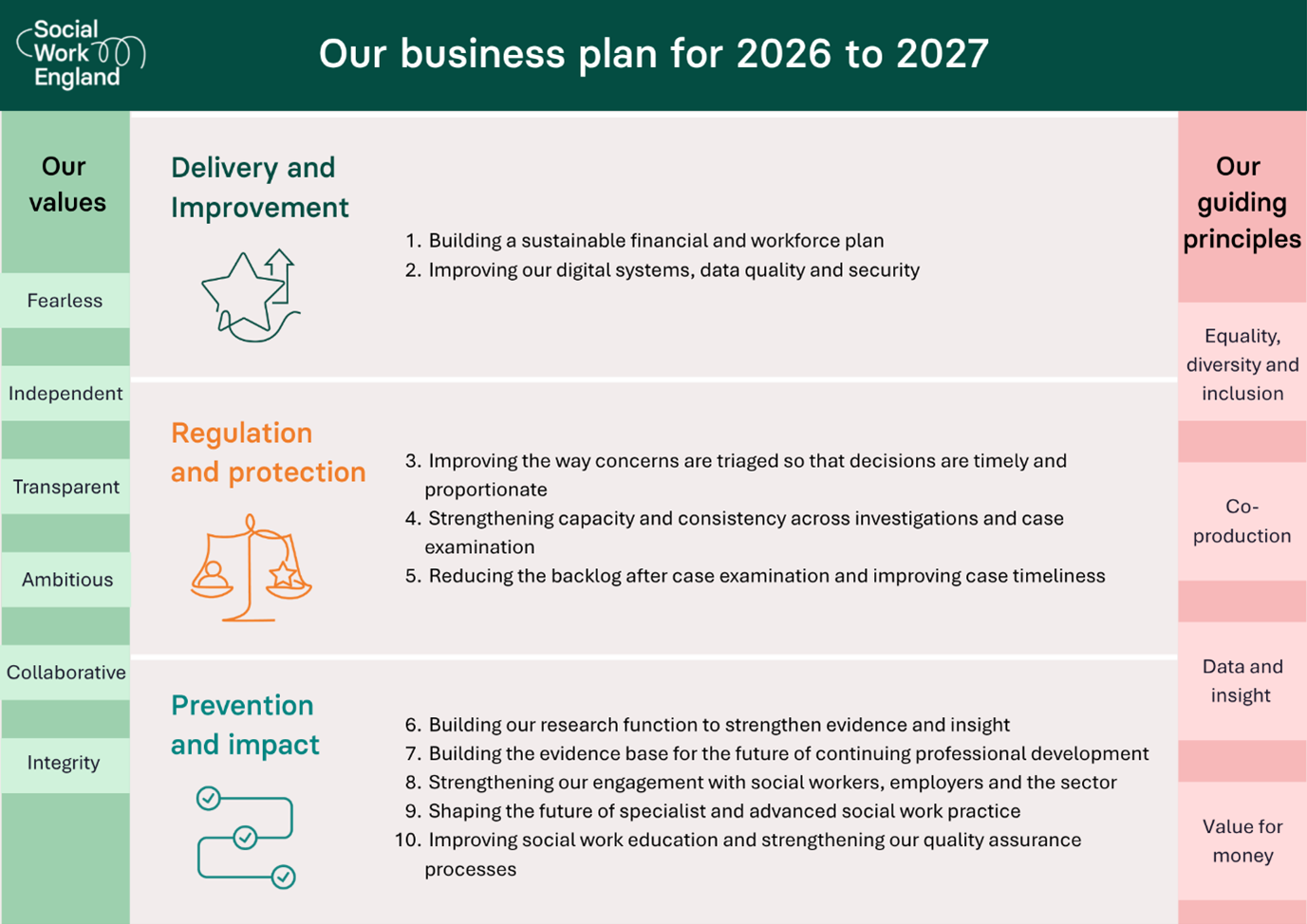
Plan on a page (accessible version)
Our values
- Fearless
- Independent
- Transparent
- Ambitious
- Collaborative
- Integrity
Our guiding principles
- Equality, diversity and inclusion
- Co-production
- Data and insight
- Value for money
Our goals
Delivery and improvement
1. Building a sustainable financial and workforce plan
2. Improving our digital systems, data quality and security
Regulation and protection
3. Improving the way concerns are triaged so that decisions are timely and proportionate
4. Strengthening capacity and consistency across investigations and case examination
5. Reducing the backlog after case examination and improving case timeliness
Prevention and impact
6. Building our research function to strengthen evidence and insight
7. Building the evidence base for the future of continuing professional development
8. Strengthening our engagement with social workers, employers and the sector
9. Shaping the future of specialist and advanced social work practice
10. Improving social work education and strengthening our quality assurance processes